
Strategic Misalignment
Enterprise priorities may not be consistently reflected in decision rights, resource choices, operating responsibilities, or the capabilities expected to support execution.
Helping institutions connect enterprise direction with governance, capabilities, processes, organisation, and integration through a coherent institutional operating architecture.
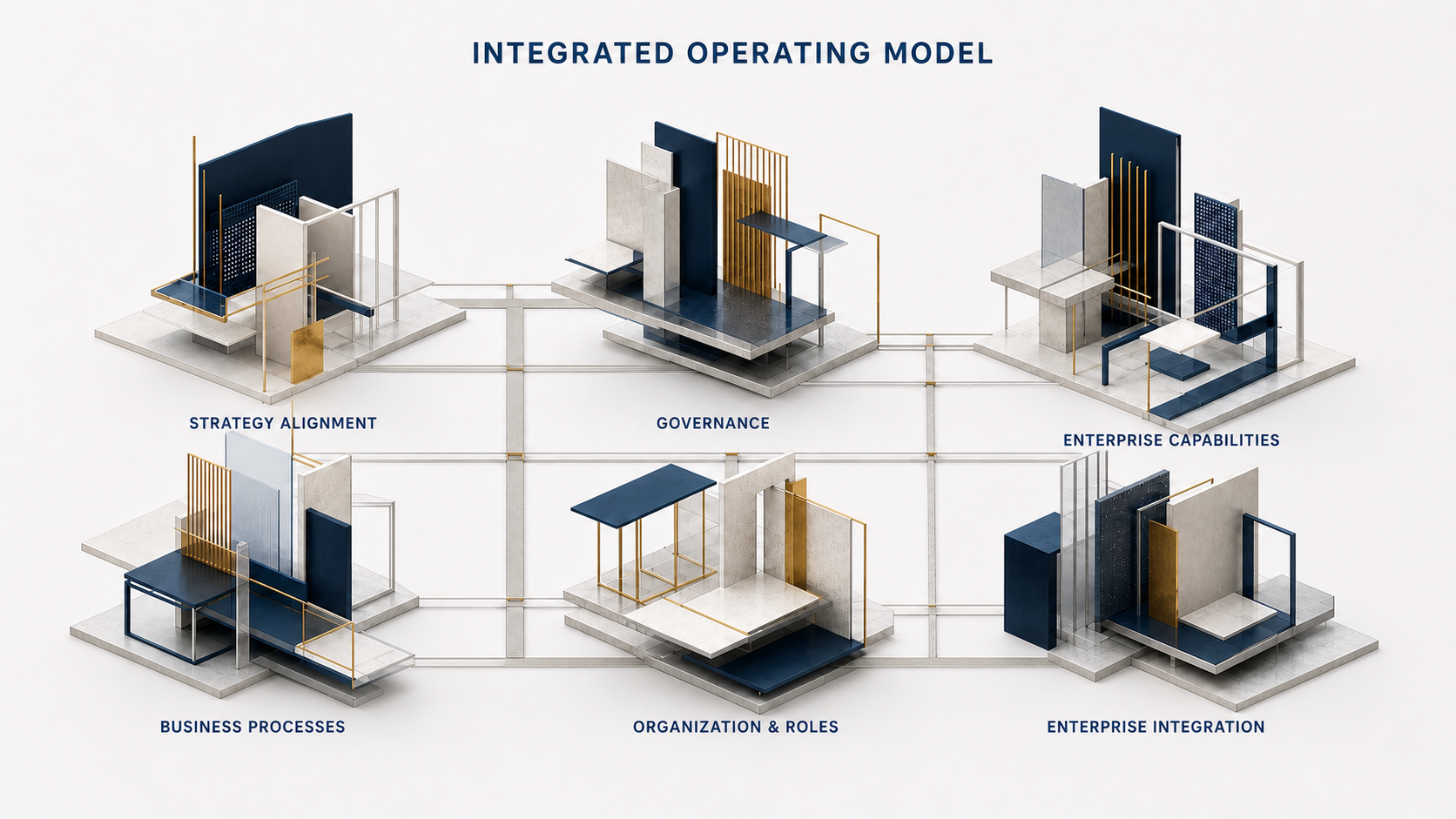
Enterprise strategy establishes direction and priorities, but execution depends on how decisions, accountabilities, capabilities, processes, organisational roles, information, technology, and resources work together across the institution.
When these elements develop independently, strategic intent may be weakened by fragmented governance, inconsistent processes, unclear ownership, duplicated capability, and limited coordination across enterprise boundaries.
Institutions may struggle to translate strategic direction into consistent enterprise action when governance, capabilities, processes, organisation, and integration are designed or managed through separate frames.
Enterprise priorities may not be consistently reflected in decision rights, resource choices, operating responsibilities, or the capabilities expected to support execution.
Critical capabilities may be distributed across functions, business units, systems, and teams without sufficient clarity about ownership, dependencies, or how they contribute to shared enterprise outcomes.
Processes may vary across the institution in ways that create duplication, hand-off gaps, uneven accountability, and difficulty coordinating work across organisational boundaries.
Overlapping forums, controls, roles, and escalation paths may obscure decision ownership, slow coordination, or separate governance activity from the operating realities it is intended to guide.
Dayananta views an operating model as an institutional operating architecture rather than a static organisation chart, process map, technology design, or collection of functional improvements.
A coherent operating model connects strategic direction with governance, enterprise capabilities, business processes, organisation and roles, and the mechanisms required to integrate decisions and activity across the institution.
Connect enterprise direction, priorities, decision principles, and resource considerations with the operating choices required to support them.
Clarify decision rights, accountability, oversight, escalation, and the relationship between institutional governance and day-to-day enterprise operation.
Identify the combinations of leadership, people, knowledge, process, technology, data, assets, and partnerships the institution requires to operate coherently.
Examine how work, decisions, information, controls, and hand-offs move across functions and organisational boundaries in support of enterprise priorities.
Consider organisational responsibilities, role clarity, collaboration, capacity, and the distribution of accountability required for coordinated execution.
Connect governance, capabilities, processes, organisation, information, technology, and resources so dependencies and operating consequences can be considered across the enterprise.
These are conceptual institutional dimensions, not proprietary framework layers, organisational design templates, service packages, assessment categories, maturity levels, or universally weighted components. Their relevance and expression depend on each institution's context.
Operating integration develops through continuing alignment among enterprise direction, governance, capabilities, processes, organisation, and integration mechanisms. The relationships are iterative and may require reconsideration as institutional conditions change.
Relate enterprise priorities and decision principles to the operating responsibilities, capabilities, and resources required to support them.
Establish clearer decision rights, accountability, oversight, and escalation across relevant enterprise boundaries.
Examine how people, knowledge, process, technology, data, assets, and partnerships combine to support institutional operation.
Improve visibility of work, decisions, information, controls, and dependencies across functions and organisational units.
Relate roles, responsibilities, capacity, collaboration, and leadership accountability to the institution's operating requirements.
Reassess alignment, evidence, risks, dependencies, and changing conditions so the operating model can remain relevant and institutionally coherent.
These interactions are a conceptual editorial frame, not a fixed sequence, workflow, maturity model, proprietary method, implementation roadmap, consulting engagement plan, or guarantee of operating improvement. They may overlap, recur, or be considered in a different order according to institutional context.
A coherent operating-model perspective may help leadership strengthen the basis on which enterprise operation is aligned, governed, connected, and reviewed.
Clearer connection between enterprise direction and the operating choices, responsibilities, capabilities, and resources intended to support it.
Greater clarity around decision rights, accountability, oversight, escalation, and the relationship between governance and enterprise operation.
A more coherent basis for coordinating processes, roles, controls, information, and dependencies across relevant organisational boundaries.
Improved capacity to reconsider roles, collaboration, capabilities, and operating arrangements as priorities and conditions change.
Better visibility of critical dependencies, capability constraints, hand-off risks, and the conditions required to sustain institutional operation.
A more integrated basis for considering long-term operating capacity, resource responsibility, stakeholder obligations, and institutional continuity.
These are intended institutional contributions, not guaranteed operational, organisational, governance, financial, growth, transformation, sustainability, stakeholder, resilience, agility, efficiency, or performance outcomes. Actual results depend on each institution's context, decisions, governance, capabilities, people, processes, technology, data, resources, stakeholders, risks, operating conditions, and execution.
Which operating choices, responsibilities, capabilities, and resources are most critical to translating the institution's direction into accountable enterprise action?
Where do decision rights, processes, roles, information, technology, and organisational boundaries require stronger clarity or connection?
Which capabilities, evidence, review disciplines, and leadership accountabilities are required to keep the operating model relevant as conditions change?
Engage with Dayananta to explore how an Operating Model perspective may support consideration of your institution's strategic alignment, governance, capabilities, processes, organisation, and integration needs.