
Fragmented Transformation Initiatives
Multiple initiatives may proceed independently without a shared view of enterprise direction, dependencies, sequencing, or cumulative institutional impact.
Helping institutions move from strategic intent toward coordinated transformation through a structured view of context, direction, capabilities, governance, execution, and adaptation.

Enterprise transformation involves more than launching initiatives or introducing new systems. It requires leadership to understand current conditions, clarify future direction, develop the capabilities needed for change, align governance and accountabilities, and sustain coordinated execution over time.
When these elements are considered separately, transformation activity can expand without producing a coherent institutional movement from strategic intent toward future-state capability.
Institutions may encounter difficulty sustaining transformation when priorities, capabilities, decisions, and execution responsibilities develop through disconnected paths.
Multiple initiatives may proceed independently without a shared view of enterprise direction, dependencies, sequencing, or cumulative institutional impact.
Transformation activity may begin before leadership has established sufficient clarity about the capabilities, operating conditions, and institutional outcomes the enterprise is seeking to develop.
Strategic ambition may move ahead of the governance, leadership, people, process, technology, data, and delivery capabilities required to support coordinated change.
Transformation plans may lose relevance when evidence, stakeholder conditions, risks, and operating realities change without a disciplined basis for review and adaptation.
Dayananta views enterprise transformation as a connected institutional journey rather than a collection of isolated projects, technologies, transactions, or short-term interventions.
A coherent transformation journey helps leadership relate current conditions, future direction, capability development, governance, coordinated execution, and institutional learning while preserving the judgement required for the institution's specific context.
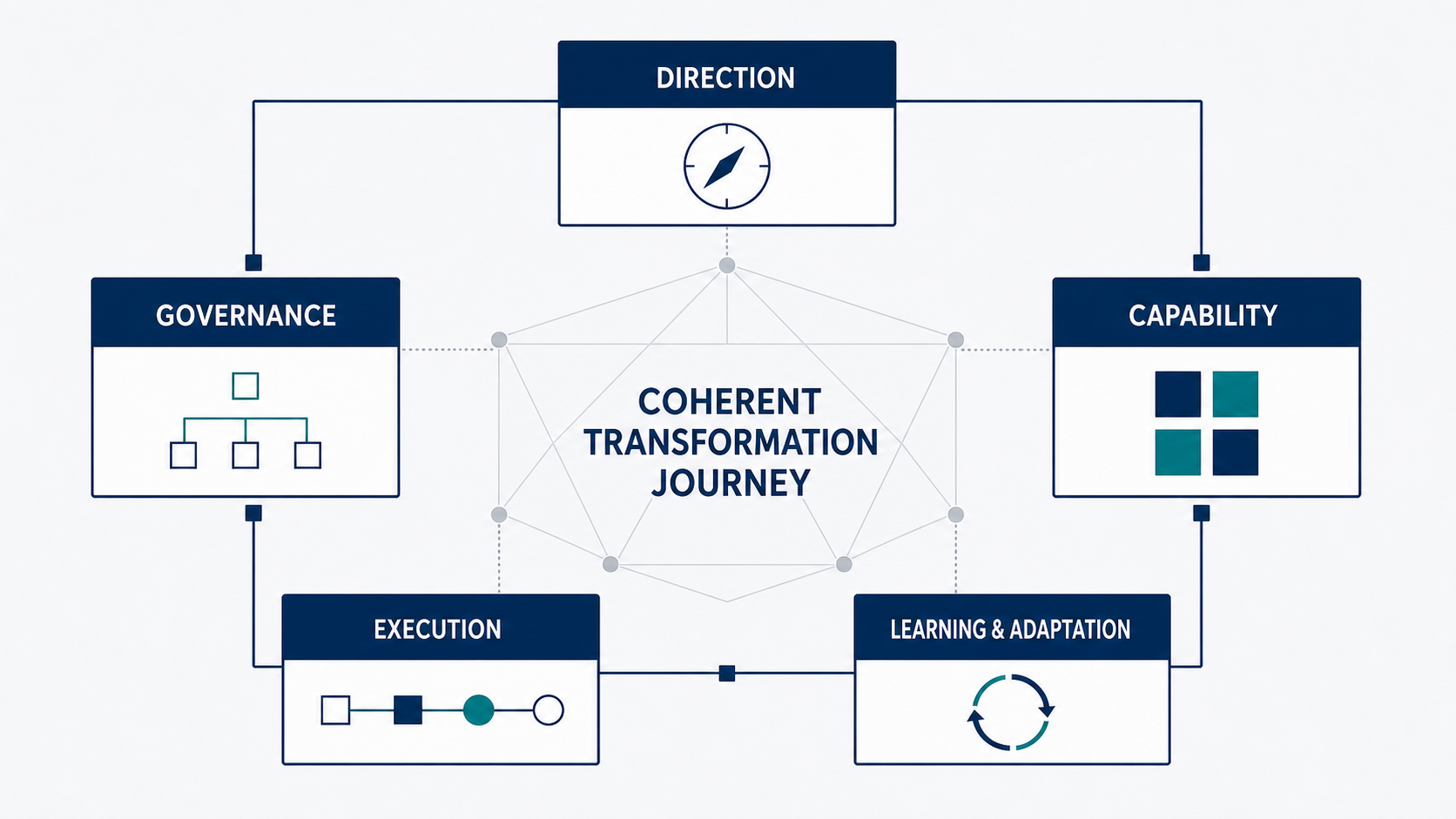
Understand the institution's purpose, current conditions, stakeholder responsibilities, operating realities, constraints, and material drivers for transformation.
Clarify the strategic intent, future capabilities, decision boundaries, and institutional conditions toward which transformation should contribute.
Consider the leadership, governance, people, process, technology, data, operating, and delivery capabilities required to support the intended direction.
Align decision rights, accountabilities, priorities, resources, sequencing, and stakeholder responsibilities for coordinated action.
Establish a disciplined basis for reviewing evidence, addressing emerging conditions, and adapting the journey as the institution learns.
The pathway provides a conceptual progression for leadership consideration. It does not prescribe a universal, strictly linear, or guaranteed transformation sequence.
Examine enterprise context, current conditions, stakeholder expectations, capabilities, constraints, dependencies, and the reasons transformation requires leadership attention.
Clarify future-state direction, intended institutional capabilities, decision principles, and the conditions that would indicate meaningful progress.
Connect governance, leadership, priorities, accountabilities, capabilities, resources, and stakeholder responsibilities around the intended direction.
Translate direction into coordinated action, sequencing, capability development, delivery ownership, evidence needs, and disciplined execution.
Review outcomes, evidence, risks, assumptions, and changing conditions so the transformation journey can adapt while maintaining institutional coherence.
The stages may overlap, recur, or require reconsideration as conditions change. They do not disclose a proprietary method, prescribe engagement phases, or constitute a delivery commitment.
A coherent transformation journey may help leadership strengthen the basis on which enterprise change is understood, governed, coordinated, and adapted.
A more coherent basis for connecting transformation priorities with institutional purpose, current conditions, and future-state capability.
Improved clarity around leadership intent, decision rights, accountabilities, dependencies, and stakeholder responsibilities.
Greater visibility of how initiatives, capabilities, resources, sequencing, and operating realities affect one another.
A structured basis for reviewing evidence, testing assumptions, learning from execution, and evolving the journey as conditions change.
These are intended institutional contributions, not guaranteed transformation, growth, financial, operational, organisational, technology, sustainability, stakeholder, governance, performance, or value outcomes. Actual results depend on each institution's context, decisions, governance, capabilities, stakeholders, operating conditions, risks, and execution.
What current conditions, institutional responsibilities, and future-state capabilities should shape the enterprise's transformation direction?
Which governance arrangements, leadership accountabilities, capabilities, dependencies, resources, and stakeholder commitments must be aligned to support coordinated movement?
What evidence, review disciplines, and learning mechanisms will help leadership assess progress, challenge assumptions, and adapt the journey responsibly?
Engage with Dayananta to explore how a Transformation Journey perspective may support consideration of your institution's direction, capabilities, governance, mobilisation, and adaptation needs.