
Systemic Isolation
Decisions and initiatives may optimise individual functions, programmes, assets, or outcomes without sufficient visibility of their wider enterprise dependencies and consequences.
Helping institutions understand how enterprise value may be created, strengthened, and sustained through the convergence of strategic direction, operational capability, financial discipline, organisational capacity, and stakeholder responsibility.
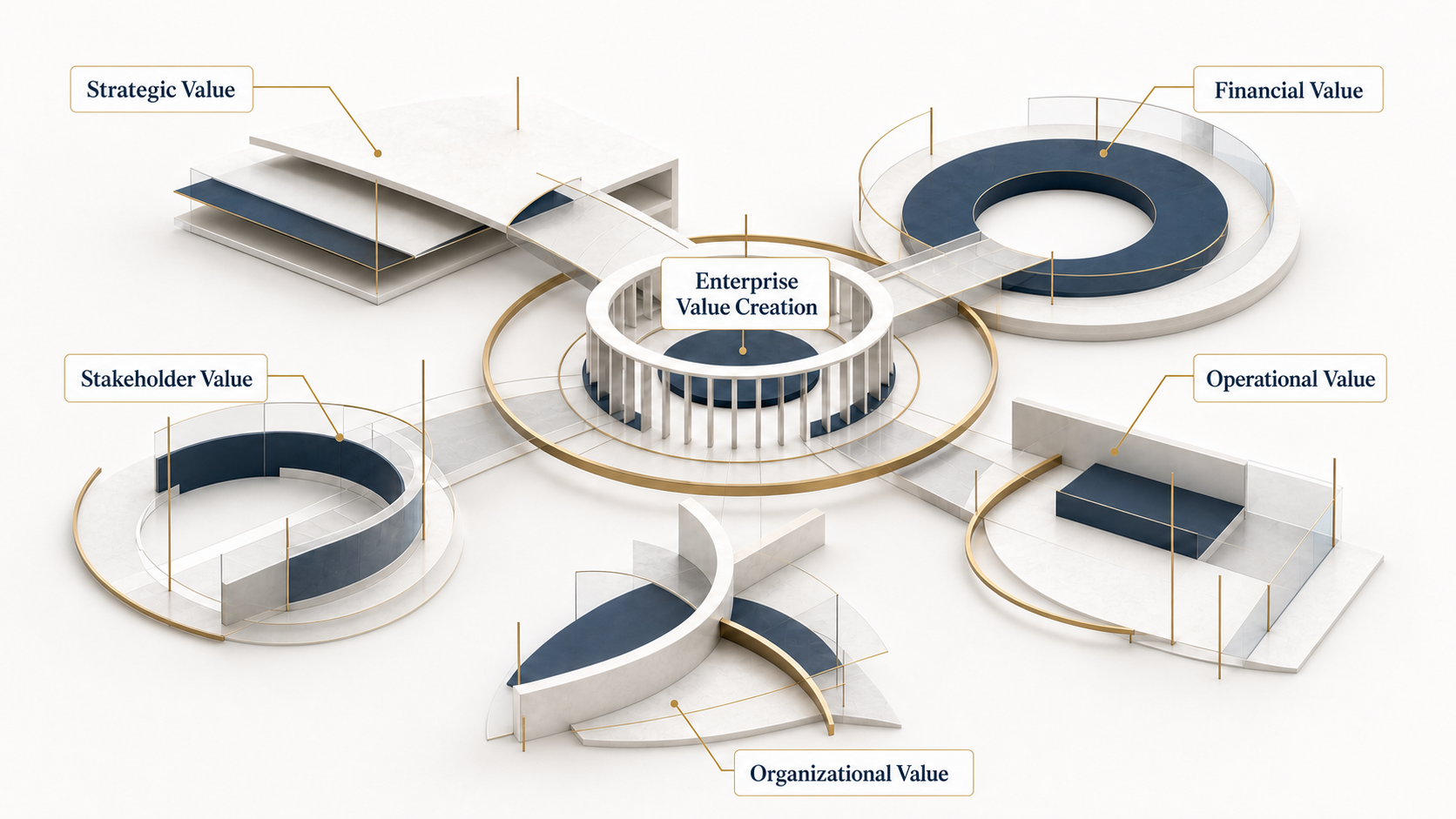
Enterprise value is shaped by more than financial performance or isolated improvement initiatives. It develops through the interaction of strategic choices, operating capabilities, capital discipline, organisational capacity, stakeholder relationships, and the institution's ability to adapt over time.
When these considerations are managed separately, activity may produce local gains while weakening alignment, resilience, accountability, or the institution's capacity to sustain value across changing conditions.
Institutions may struggle to create and sustain value when strategic intent, operating choices, capabilities, capital decisions, and stakeholder responsibilities are considered through disconnected frames.
Decisions and initiatives may optimise individual functions, programmes, assets, or outcomes without sufficient visibility of their wider enterprise dependencies and consequences.
Competing priorities, decision horizons, incentives, and stakeholder expectations may weaken alignment between institutional direction and the choices made across the enterprise.
Value ambitions may exceed the governance, leadership, people, process, technology, data, financial, and execution capabilities required to support and sustain them.
Dayananta views enterprise value creation as an institutional question rather than a collection of isolated financial, operational, organisational, technology, sustainability, or stakeholder initiatives.
Enterprise convergence brings strategic direction, capabilities, operating choices, capital discipline, organisational capacity, and stakeholder responsibilities into a more coherent frame so leadership can consider how value is created, strengthened, balanced, and sustained.
The value supported by clear institutional direction, relevant choices, coherent priorities, and the capacity to position the enterprise responsibly for changing conditions.
The value strengthened through effective operating capabilities, connected processes, disciplined execution, resilience, and the responsible use of technology, data, and resources.
The value supported by capital discipline, financial resilience, informed resource allocation, and consideration of long-term institutional sustainability without reducing enterprise value to financial returns alone.
The value embedded in leadership, governance, people, culture, knowledge, collaboration, accountability, and the institution's capacity to learn and adapt.
The value shaped through responsible relationships with customers, employees, partners, communities, government, investors or funders, and other stakeholders relevant to the institution's purpose and context.
These are conceptual institutional dimensions, not proprietary framework layers, investment categories, valuation factors, maturity levels, workstreams, service packages, scores, certifications, or links to other pages.
The dimensions are interdependent. The page must not present them as automatically additive, universally weighted, mutually exclusive, or reducible to a single score.
This journey illustrates a conceptual evolution in how leadership may understand and strengthen enterprise value. It does not prescribe universal maturity levels, a fixed engagement sequence, or guaranteed progression.
Identify how value is currently understood, where it is created or constrained, which stakeholders are affected, and where fragmented decisions or capability gaps may erode institutional value.
Relate strategic, operational, financial, organisational, and stakeholder considerations so their dependencies, tensions, and potential reinforcing effects become more visible.
Align governance, capabilities, priorities, resources, accountabilities, and evidence around the institution's context-specific value considerations.
Review outcomes, risks, stakeholder conditions, assumptions, and changing enterprise realities so value considerations can remain relevant, responsible, and resilient over time.
The stages may overlap, recur, or require reconsideration as institutional conditions change. They are a conceptual editorial progression, not a proprietary method, DEGA lifecycle, consulting engagement phase, assessment scale, maturity certification, investment process, fixed-duration roadmap, or delivery commitment.
An enterprise value perspective may help leadership strengthen the basis on which value-related choices are understood, governed, connected, and reviewed.
A more coherent basis for defining which forms of value matter to the institution, its purpose, responsibilities, stakeholders, and long-term direction.
Greater visibility of how strategic, operational, financial, organisational, and stakeholder choices affect and constrain one another.
Improved clarity around priorities, governance, capabilities, resources, accountabilities, and stakeholder responsibilities relevant to value creation.
A more disciplined basis for reviewing evidence, addressing risks and trade-offs, adapting to changing conditions, and strengthening the institution's capacity to sustain value over time.
These are intended institutional contributions, not guaranteed financial returns, valuation changes, growth, transformation, operational, organisational, sustainability, stakeholder, governance, performance, investment, or other value outcomes. Actual results depend on each institution's context, decisions, governance, capabilities, stakeholders, capital conditions, operating environment, risks, and execution.
Which forms of value are most relevant to the institution's purpose, responsibilities, stakeholders, context, and long-term direction?
How do strategic, operational, financial, organisational, and stakeholder choices reinforce, constrain, or redistribute value across the enterprise?
Which governance arrangements, capabilities, evidence, accountabilities, and adaptation disciplines are required to strengthen and sustain value responsibly?
Engage with Dayananta to explore how an Enterprise Value Creation perspective may support consideration of your institution's value priorities, interdependencies, capabilities, and long-term sustainability.