
Fragmented Enterprise Priorities
Strategic, financial, sustainability, digital, and operating priorities may advance independently without a shared view of enterprise dependencies, trade-offs, and sequencing.
Enterprise Growth Architecture™
Helping institutions examine growth as a connected enterprise challenge across strategy, governance, capabilities, operating alignment, transformation, and value creation.

Enterprise growth rarely depends on a single strategic choice, investment, operating initiative, or transformation programme. It develops through connected decisions involving direction, governance, capital, capabilities, technology, stakeholders, and execution.
Leadership therefore needs a coherent view of how these elements interact, where institutional dependencies exist, and which conditions must be aligned as the enterprise responds to changing priorities and operating realities.
Institutions may struggle to sustain coherent growth when strategic direction, governance, capabilities, investment, transformation, and execution evolve through separate decision frames.
Strategic, financial, sustainability, digital, and operating priorities may advance independently without a shared view of enterprise dependencies, trade-offs, and sequencing.
Decision rights, accountability, evidence, and oversight may remain distributed across functions without a sufficiently connected structure for enterprise-level choices.
Growth ambitions may exceed the institution’s current operating capacity, leadership alignment, organisational capabilities, technology environment, or ability to coordinate change.
Initiatives may move into delivery while assumptions, dependencies, stakeholder conditions, and enterprise priorities continue to change around them.
Dayananta approaches enterprise growth through an integrative perspective that connects strategic direction, governance, organisational capability, financial discipline, sustainability, technology, operating realities, and execution.
This perspective helps leadership examine the enterprise as a set of interdependent decisions and capabilities, clarify where alignment is required, and consider how growth priorities can be governed and advanced within the institution’s specific context.
Enterprise Growth Architecture™ provides a shared frame for examining connected growth decisions; it does not replace leadership judgement, institutional governance, or context-specific execution.
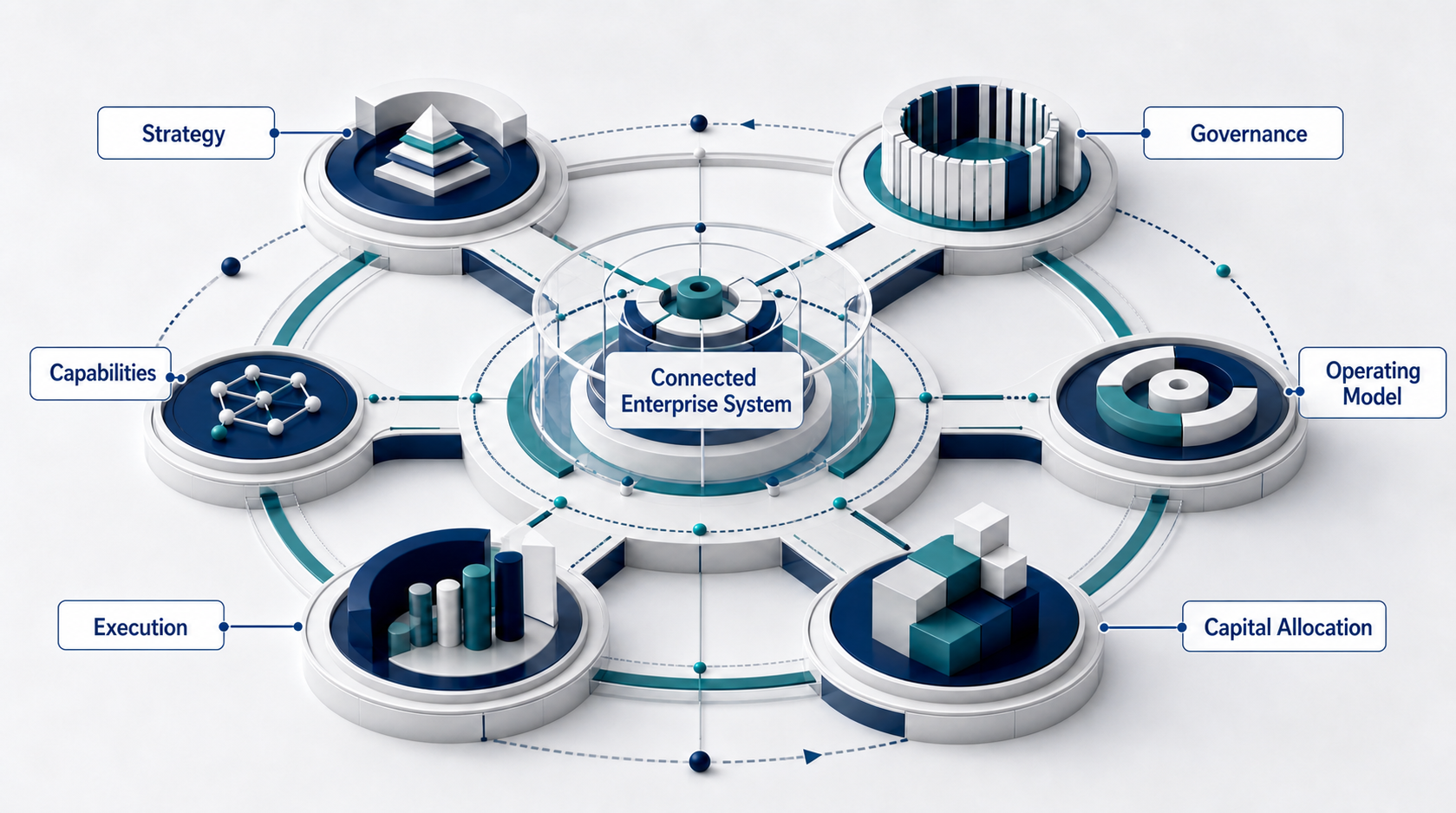
Clarify enterprise intent, priorities, decision criteria, trade-offs, and the strategic boundaries within which growth choices are considered.
Examine decision rights, accountability, stakeholder responsibilities, oversight, and the alignment required across leadership and the wider institution.
Consider how capital choices, financial discipline, long-term value, material sustainability priorities, and institutional responsibilities interact.
Connect operating model, organisational capability, processes, technology, data, and transformation priorities with the enterprise direction they are intended to support.
Strengthen the disciplines through which priorities are mobilised, evidence is reviewed, dependencies are managed, and the enterprise adapts as conditions change.
Examine enterprise context, stakeholder conditions, strategic priorities, governance, capabilities, operating realities, existing initiatives, and material constraints.
Define the growth questions, decision boundaries, dependencies, evidence, and trade-offs that require leadership attention.
Develop a coherent enterprise direction connecting strategic choices, governance, capabilities, capital, transformation, value considerations, and sequencing.
Clarify accountability, decision rights, resources, operating responsibilities, stakeholder engagement, and the conditions needed to mobilise the approved direction.
Review evidence, test assumptions, strengthen institutional learning, and adapt priorities and capabilities as enterprise conditions change.
When enterprise direction, governance, capabilities, capital, transformation, and execution are considered together, institutions may be better positioned to pursue the following intended outcomes.
A more coherent basis for examining priorities, trade-offs, dependencies, and sequencing.
Stronger visibility of how choices across strategy, governance, finance, sustainability, operations, and technology affect one another.
Greater clarity around leadership accountability, decision rights, capabilities, and operating responsibilities.
A more structured basis for reviewing evidence, learning from execution, and evolving priorities as conditions change.
These are intended institutional contributions, not guaranteed strategic, financial, sustainability, digital, operational, growth, performance, value, governance, or stakeholder outcomes. Actual results depend on each institution’s context, decisions, governance, capabilities, stakeholders, operating conditions, and execution.
Which growth priorities matter most to enterprise purpose, stakeholder responsibilities, long-term value, and the institution’s actual capacity to advance them?
Which decisions, dependencies, accountabilities, and evidence must be connected to keep enterprise growth coherent?
What operating capabilities, leadership disciplines, and learning mechanisms are required to advance and evolve the direction responsibly?
Engage with Dayananta to explore how an Enterprise Growth Architecture perspective may support consideration of your institution’s growth priorities, dependencies, and alignment needs.